
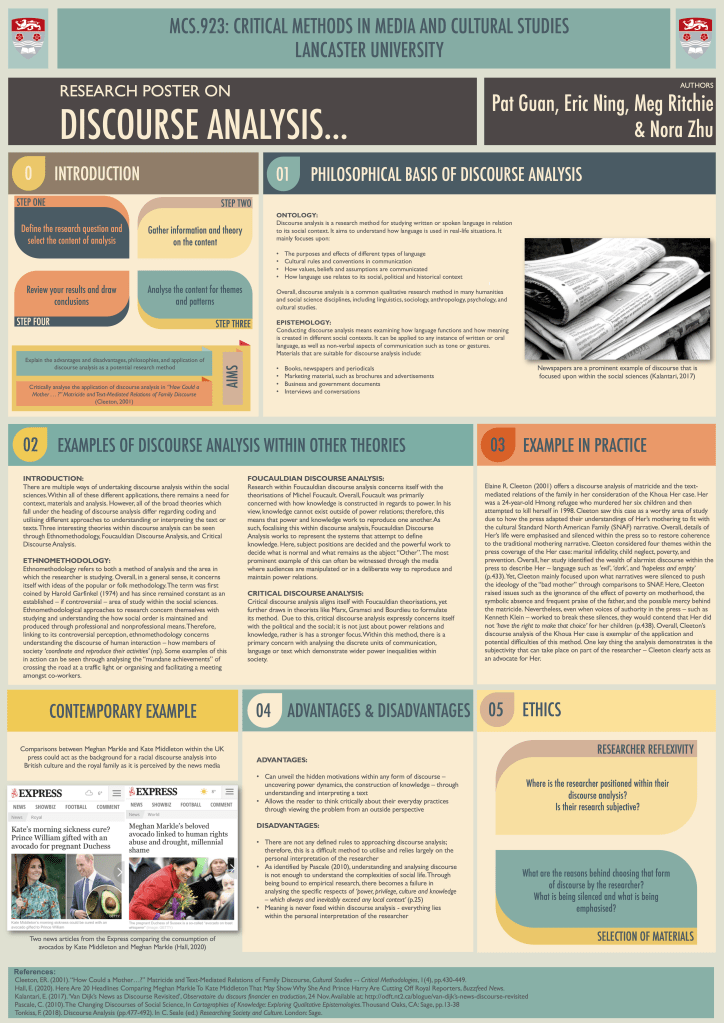
Discuss the advantages and disadvantages of visual analysis based on Roland Barthes’ “Camera Lucida” (1981), comparing it to discourse analysis.

In Camera Lucida (1981), Roland Barthes offers an unconscious account of visual analysis in practice. “Unconscious” is appropriate to this discussion as he does not define visual analysis. Regarding this, Marita Sturken and Lisa Cartwright (1998) comment that visual images are ‘central to how we represent, make meaning, and communicate with the world around us’ (p.1). Hence, visual analysis becomes a method for extracting meanings and representations to make sense of society. 

However, firstly, there needs to be a consideration into how Fran Tonkiss (2018) and Roland Barthes present their research methods before comparing them. Whilst Tonkiss takes an objective or methodological “how-to” stance towards discourse analysis, Barthes’ work is writing on the visual. Hence, in comparing the advantages and disadvantages of utilising the two methods, Barthes is lacking as his work does not act as a traditional guide. Nevertheless, though the writing styles possess different intentions, there are still some advantages and disadvantages which can be established. 

The main advantage of Barthes is that he establishes a greater sense of agency within his application of visual analysis. Regarding agency, Tonkiss only briefly mentions the problems of “expert language” which create ‘a field of knowledge or expertise [that] confers membership and bestows authority’ (p.481). Though considering how examining “expert language” discourse can reveal social issues and problems, Tonkiss fails in asking where knowledge comes from. 

Contrastingly, Barthes establishes that a key aspect within visual analysis is understanding how visual media is ‘the object of three practices…to do, to undergo, to look’ (p.9). From this he establishes three positions in the creation and appreciation of an image: the Operator, the Spectator, and the Spectrum. From offering these positions, Barthes articulates how the photographer – the Operator – always controls the meaning of an image. Hence, understanding agency within an image allows for a greater understanding and analysis of a piece of visual media. 

Nevertheless, a major disadvantage to visual analysis is that it is highly subjective. Aside from demonstrating this within his first-person account of photography, Barthes further relents that ‘the reading of public photographs is always, at bottom, a private reading’ (p.97). Here, Barthes identifies how visual analysis is primarily personal. This is clearly established when discussing the punctum – ‘the element which rises from the scene…and pierces me’ (p.26). The punctum can only exist within the individual – ‘what I add to the photograph’ (p.55) – and henceforth cannot be deliberately placed by the Operator. The punctum organically generates affect. Hence, discussions of agency when considering subjectivity become obsolete as a large portion of an image’s meaning – and sometimes its power – come from the viewer over the creator.

Yet, a key concern here is whether these respective advantages and disadvantages are relevant to their methods or authors. For example, if Barthes wrote about discourse analysis in the same first-person and experiential manner, the method becomes subjective. Contrastingly, if Tonkiss approached visual analysis from a methodological “how-to” stance, one could argue that the method falls prey to the problem of ‘objective knowledge’ outlined by Pascale (2010, p.19) due to its failure of reflexivity. 

Overall, discussing the comparative advantages and disadvantages of research methods is an arduous task as the individual researcher is often part-and-parcel of the failings or successes of a method. Therefore, these methods cannot be detached from their authors. 

References:

Barthes, R. (1981). Camera Lucida. New York: Hill and Wang.

Pascale, C. (2010). The Changing Discourses of Social Science, In Cartographies of Knowledge: Exploring Qualitative Epistemologies. Thousand Oaks, CA: Sage, pp.13-38.

Sturken, M. and Cartwright, L. (2001). Practices of Looking: An Introduction to Visual Culture. Oxford: Oxford University Press.

Tonkiss, F. (2018). Discourse Analysis (pp.477-492). In C. Seale (ed.) Researching Society and Culture. London: Sage.

What are the particular difficulties that researchers face when there are no step by step procedures to follow, yet there is a requirement for the systematic analysis of a dataset?

When having no step by step procedures to follow in the process of discourse analysis, the researchers are facing many difficulties. Discourse analysis mainly focus on language and texts, in which social meanings, social identities and social facts are formed and reproduced (Tonkiss, 2018). Through the discourse analysis, it examines how ideologies are reproduced by language and texts (Fairclough, 1995), and how discourse can be understood in relation to historical processes and events (Wodak, 2011). Hence, in the social and political context, the researchers see language as crucial to the ways that power is reproduced, legitimated and exercised within social relations and institutions (Tonkiss, 2018: 408).

It is challenging in selecting and approaching data. According to different research problems, the source of data collection is also broader. In political and policy discourse, language helps to reproduce and reinforce social power, which can lead to cultural hegemony. For researchers, they need to be sensitive to the different kinds of discourse that are at stake, and they have to be clear about their rationale for choosing certain kinds of data, their strategy for collecting it (Tonkiss, 2018: 411). The abundance and availability of media texts poses a real challenge for the researcher in selecting a manageable amount of relevant data (Tonkiss, 2018). 

The difficulties also appeared in the process of sorting, coding and analyzing data. It presents that data in discourse analysis picks up by doing and perfects by practising. Tonkiss notes that the text also provides a framework on which to consider its inconsistencies, internal workings and small strategies of meaning (Tonkiss, 2018: 412). 

The last possible difficult is happened in presenting the analysis. Internal and external validity is significant to be considered by researchers, referring to the coherence and consistency. Discourse analysis is typically concern with internal validity. They do close textual work to develop arguments on the basis of detailed interpretation of data (Tonkiss, 2018).

Reference

Tonkiss, F. (2018). Discourse Analysis (pp.477-492). In C. Seale (ed.) Researching Society and Culture. London: Sage.

What are the particular difficulties that researchers face when there are no step by step procedures to follow, yet there is a requirement for the systematic analysis of a dataset?

In definition of discourse analysis, theorist Fran Tonkiss (2018) notes that there are key difficulties facing researchers who utilise this method. Overall, discourse analysis acts as an insight into the effects of ‘speech and texts’ on the shaping and reproduction of knowledge and social meaning (p.478). When considering critical or political discourse analysis, this method can further demonstrate how languages and texts perform and reproduce an ideology. Ergo, critical discourse analysis becomes intertwined with power and hegemony – how discourse is ‘reproduced, legitimised and exercised’ within society and through social institutions (p.480). 

The difficulty is that discourse analysis is perceived as a “craft skill” (Potter and Wetherell, 1994, p.55 in Tonkiss, 2018, p.485); it has no strict rules, rather it can only be learned through doing. However, Tonkiss identifies that simply having a familiarity with a dataset – or understanding its “interpretive repertoires” – can help in creating ‘a framework in which to consider its inconsistencies, internal workings and small strategies of meaning’ (p.485). As such, discourse analysis becomes highly subjective and interpretive on part of the researcher. Nevertheless, Tonkiss presents four useful starting points for analysing a piece of discourse which could act as its pseudo-rules: 

‘Identifying key themes and arguments.

Looking for association and variation.

Examining characterisation and agency.

Paying attention to emphasis and silences.’

(p.486)

The utilisation of these “rules” can be seen through the discourse analysis of UK media coverage of refugees researched by Philo, Briant and Donald (2013). This case study gathers its research sample from both television and press media in the week of June 2nd, 2011 and focuses its discourse analysis on ‘asylum-related broadcasts’ (p.87). This sample period was chosen because the government backlog in asylum cases, originally reported in 2006, was cleared during this week. As such, there was a milieu of discourse demonstrating knowledge production and ideology regarding refugees. 

Firstly, Philo et al. divided their research under recurring themes – such as ‘conflation of forced economic migration’ – and then further separated this into television and press news reporting (p.95). From this, the researchers could understand shared and contrasting views across the news media and therefore understand what ideology is being presented and how it may shape knowledge. One interesting thing Philo et al. observed within their research were silences regarding the term “asylum seeker” or “undocumented immigrant” – as preferred terms by the United Nations – versus the emphasis placed upon illegality. More so, they observed a silence through ‘read[ing] against the grain’ in their discussion of Lunchtime News’ decision not to use the term “illegal immigrant” (Tonkiss, 2018, p.490).  Even though they did not use this negative term, they frame an ideology that ‘asylum seekers might not be “genuine”’ through the context of their discussion (Philo et al., 2013, p.99). Therefore, their silence demonstrates their ideology. 

In conclusion, the main issue discourse analysts face when approaching a dataset is a lack of linearity or rules. Yet, to overcome this hurdle, researchers can use their understanding of a text – for example, viewing recurring themes, identifying who is given agency, considering what is not said – to create a framework. Therefore, as Tonkiss notes, the research becomes less about ‘looking for conclusive answers’ and rather ‘looking at…both the problem, and possible solutions’ as a means to construct meaning (p.482).

References:

Tonkiss, F. (2018). Discourse Analysis (pp.477-492). In C. Seale (ed.) Researching Society and Culture. London: Sage.
Philo, G., Briant, E.,and Donald, P. (2013). Case Studies of Media Content, 2011 (pp.87-130). In Bad News for Refugees. London: Pluto Press.

Obstacles researchers facing without gradual procedures

There will be great difficulties for researchers to analyze a dataset without step by step procedures. According to what we’ve read in Cartographies of Knowledge, Celine-Marie Pascale discourses that on one hand, they must develop critiques of existing paradigms and on the other they must develop research that demonstrates the strength of the new frameworks(2010, 23).  It means that during the process of formalization, which refers to identifying pertinent phenomena and problems and converting them to data, researchers have to fully understand, look into and analyze what is conveyed in present models. Also, to show the power of the new knowledge, they have to conduct inquiries and investigations. And Pascale states that at the start of the 21st century, one of the characteristics of research methodologies must be the capacity to excavate the full range of social life, including the ways that it is mediated by technologies. In order to continue to develop a vision for social research that is capable of being fully compatible with a vision of a socially just world, scholars need to consistently explore, not only our own locations as researchers but also, the philosophical foundations and working assumptions of social research paradigms(2010,27). That is to say, constant inspection and probe targeting various groups of people is inevitable for the purpose of revealing an overall world. It’s not hard to tell that scholars must spend considerable time and effort to survey as many people as they can, study and translate what they’ve obtained into the new knowledge. Meanwhile, interpreting the data is a challenging task as well cause social behavior is not governed by fixed natural laws. Therefore, it’s a tough challenge for researchers without step by step procedures to follow while they are required to analyze a dataset systematically.

By Shuangjiao Guan

The difficult researchers face in analyzing the data-bias

As for the analysis of data, without specific steps, it will not be straightforward to operate. As for the difficulties in data processing, Tonkiss thinks they mainly focus on the following points: defining research problems, selecting and obtaining data, classifying, compiling, and analyzing data. I want to focus on the “Sorting, coding, and analyzing data” section (Tonkiss, 2011).

The difficulty for discourse analysts in the study of discourse analysis is how to look for the stringency of interpretation and the internal consistency of arguments. Analysis of discourse is an interpretive process that relies on careful study of specific texts. The first thing the analyst of the debate has to do is drop all preconceptions (Tonkiss, 2011). Here is an example of how vital the neutrality of discourse analysis is. 

In August 2015, the documentary “Secrets of China” produced by BBC attracted full attention from many audiences once it was broadcast. The documentary starts with hot social topics such as the education system, social pressure, and the gap between the rich and the poor, showing Chinese young people’s responses and thoughts to a series of social realities such as love, wealth, leisure, education and pressure. The word choice of the documentary was the first to be criticized by many Chinese audiences. At the lexical level of a language system, the same word can usually convey a variety of messages, and the same message can also be expressed through different words. Researchers are often faced with the problem of how to choose words to convey information. In the documentary “Secrets of China”, researchers mostly use the strategy of the ideological square. This strategy is characterized by positive self-presentation and negative other-presentation (Van Dijk, 1998).

For example, the documentary frequently mentions in the commentary showing the attitude of Chinese young people towards online games (League of Legends): “For us (British youth), League of Legends is a kind of moderate entertainment, while they (young Chinese) are addicted to this game.” Moreover, when describing the academic pressures faced by young Chinese students, the documentary continually reminds the audience: “Our (British) studies were relaxing, and they (the Chinese youth), busy from morning till night, almost choked (BBC,2015).”

For the researchers of this documentary, he believed that his values, recognized political system, and way of life were the only advanced mode with global universality. Any alternative approach to development that does not conform to its values and social system is considered heretical and antithetical (Zhu and Huang, 2017). I do not deny that in discourse analysis, if researchers can integrate their views when they are doing discourse analysis, they may give the audience more thinking angles. However, if the researcher carries out discourse analysis with too much personal bias and does not follow the facts, what is the purpose of discourse analysis? Is it to get people to admit what they agree with?

The discourse analysis may sometimes impose an interpretation on the sample of the discourse, but the evidence does not support this and thus does not provide a compelling analysis. The analytical assertions should instead be based on textual evidence and detailed evidence. In this regard, discourse analysts need to work on challenging the knowledge of common sense and undermining simple assumptions about organizing social meaning (Tonkiss, 2011).

Reference 

BBC NEWS, 2015. Secrets Of China (2015) Season 1 Episode 1. Available at: <https://youtu.be/VDECYSZI8J8&gt; [Accessed 2 August 2020].

Tonkiss, Fan. 2004 “Discourse Analysis.” In Researching Society and Culture, ed by. Clive Seale, 405–423. Thousand Oaks, CA: Sage.

van Dijk, T., 1998. Ideology: A Multidisciplinary Approach.

Zhu, G. and Huang, J., 2017. A Study on the Image of Chinese Youth from the perspective of Western mainstream Media — A critical discourse analysis based on the BBC documentary Secrets of China. China Youth Study, 05(1002-9931), p.107.

Create your own website, free on WordPress.com.Create your own website.
Start free